Rollins, Landry address mealybugs, diesel relief
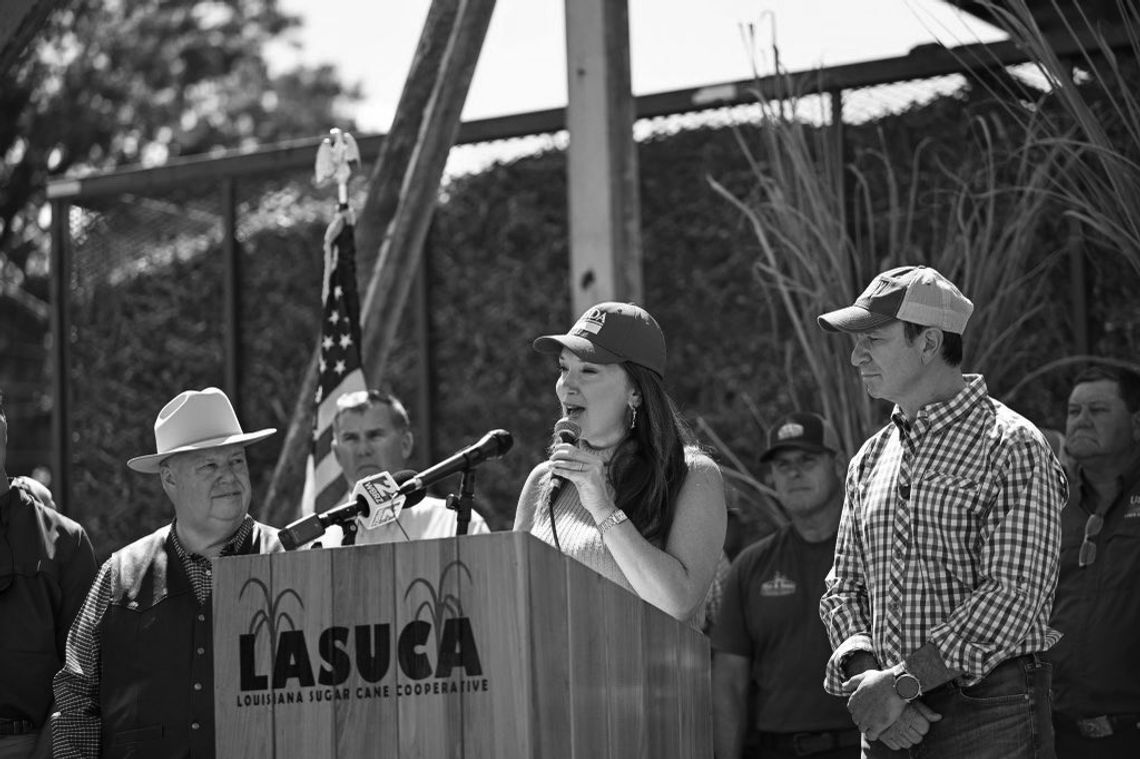
– The state and federal government are looking to provide help to sugar cane farmers in the face of rising diesel prices, threats from invasive species and efforts to expedite work visas for temporary agriculture workers, US Secretary of Agriculture Brooke Rollins and Louisiana Gov. Jeff Landry said Friday after touring the Louisiana Sugar Cane Cooperative factory grounds on Friday.
Rollins addressed the pasture mealybug pest that has spread from Texas into Louisiana. Though LaSuCa Manager John Hebert said the pasture mealybug has not hit the parishes that the mill serves yet, it remains a concern for farmers in the state.
“The reason I’m here, putting farmers first also means leading robust responses to protect producers from diseases and pests that threaten their livelihood, something we’ve done with great success,” she said, noting responses to HPAI that affected poultry and New World screwworm that affects cattle. “The next thing on the list, which is a really big deal here in Louisiana, is the pasture mealybug, which has emerged as a serious threat not only to sugar cane growers here in Louisiana but also to farmers in Florida, Texas and Georgia. This invasive pest feeds on warm-season perennial grasses and affects crops including sugar cane.”
“This is a monumental opportunity,” Hebert said. “On behalf of the Louisiana Sugar Cooperative, its 14 member directors and all of its member growers as well as the staff, thank you for choosing us to come and represent the industry. Governor, also, thank you for recognizing us as your home mill. We’re real proud of that.
“I just want to say that these two individuals have done so much for the Louisiana sugar industry just within this year.”
The U.S. Department of Agriculture released a coordinated action plan outlining its response to the pest in Louisiana, Texas, Florida and Georgia. Rollins also said that USDA awarded $500,000 to the LSU AgCenter to help researchers detect the pest, control outbreaks, identify resistant sugar cane varieties and give farmers practical tools to protect their harvests. Funding for the USDA Plant Pest and Disease program was increased by $90 million in the Working Families Tax Cuts Act.
“USDA is working with our state and local partners on an aggressive, coordinated response so that we can strengthen outreach and awareness as well as advance new tools so that we can fight back against this pest,” she said. “This includes working with my good friend, EPA Administrator Lee Zelden to ensure that Section 18 emergency exemptions are quickly approved when growers identify a potential solution, just as we did with the New World screwworm.”
Timely detection of the mealybug and accelerating scientific research, including conducting insecticide efficacy trials in Louisiana, are the start of the effort. A coordinated communications response and continuing to partner with states on proactive management and mitigation tactics help further the effort, she said.
“We have declared the pasture mealybug as a priority pest for the upcoming fiscal year and our animal and plant health inspection (APHUS) plant pest and disease management program, which means that it will get the majority of time, effort and money moving forward,” Rollins said.
“I don’t think there can be enough emphasis put on to how important this (fight with the pasture mealybug) has been to us,” Hebert said. “I made the statement to Secretary Rollins earlier, I think basically everyone in the industry this year has had a pit in their stomach over what they expect from the results of pasture mealybug infestation, because we knew from some late infestations in 2025 that the effects could be detrimental to us. You’ve worked together with our industry to give us an opportunity and the resources in such a short span of time to combat this insect, and I’m very pleased to say that we’re seeing satisfactory sugar numbers this year, above what we all could have expected.”
American Sugar Cane League President Jim Simon said that the response to the pasture mealybug threat shows what can come of a partnership between the ASCL, the LSU Ag-Center and the USDA.
“The commitment to research is critical,” he said. “When we combine our forces, and we have wonderful advocates working on our behalf, like you, Madam Secretary, and all of your research team, we can make remarkable things happen. And the evidence is on this pasture mealybug, a horrible pest that we had to face. Our consultant community, researchers, American Sugar Cane League, our growers, and their work all came together to fight this.
Rollins noted that commodities prices are increasing, helping farm profitability, including rice up 12 percent, cotton up 18 percent and sugar cane up 9 percent in the last year and a half since she took office. Sugar cane accounts for about 33 percent of the planted acres in the state.
“The most important thing we can do to ensure long-term prosperity for our farmers and for all of rural America is to empower our producers to compete and to win on the world stage, and we’re working to do that as well,” Rollins said.
“We hear you loud and clear, Louisiana, we hear you loud and clear, our sugar cane growers. We know what it means to put American farming first. We know that in order to really save this country and to preserve the American dream, we can’t do it without the best among us who are our farmers and ranchers. And we will continue to do everything in our power to make sure that for another 150 years this incredible mill will continue to operate alongside our sugar cane farmers.”
Rollins and Landry both spoke about recent groundbreaking ceremonies for two fertilizer plants in Louisiana.
“I think that today is proof again of President Trump and his administration’s promise to put America first,” Landry said. “Because America needs to remember that a country that cannot feed itself cannot defend itself.
“Louisiana has such a vital role to play when it comes to feeding this country. Not only is it our farmers here in Louisiana like our sugar farmers here, but also as Brooke talked about, our fertilizer industry that has been growing strong because of the policies that the Trump administration has put in place.”
With diesel prices reaching a national average of $6.52 a gallon last week and state prices hitting a record $6.03 average, the governor signed an executive order this past Wednesday allowing farmers and foresters to use nontaxable, dyed offroad diesel in Farm Use and Forest Products vehicles on the roadways without having to pay the additional 44 cents per gallon federal and state taxes for on-road vehicle use. (See related stories, Pages A1 and A2.)
That order runs from Sept. 23 to Oct. 22.
“The most recent development with the relief on tax for harvesting operations within the Louisiana industry is just phenomenal, and it means a great deal to us,” Hebert said of the executive order. “We can’t thank you enough for that relief, because it’s so important in this time.”
Landry said that he understands the economic impact of a farm.
“One of my first jobs was hauling sugar to this very mill,” Landry said. “So believe you me, I understand the economic impact of that.”
Rollins said the efforts are a short-term bridge as the federal government hopes to wrap up the conflict with Iran that has driven fuel prices up.
Rollins said the tour showed off the state’s big agricultural crop, which at $1.51 billion annually trails only forestry ($3.48 billion) and poultry ($1.87 billion) among the state’s agricultural products.
Sugar cane accounts for 17,000 jobs and has a $4 billion economic impact on the state, she noted after touring one of the state’s longestrunning sugar mills, which has been going since the 1860s.
“We just finished about an hour tour, getting to see first-hand one of America’s longest (standing) and greatest industries, and that’s our sugar cane industry, and how important it is as an economic driver, how important it is to Louisiana,” Rollins said. “It’s really, really inspiring to see it firsthand.”
Louisiana Secretary of Agriculture Mike Strain said that Louisiana is the largest producer of cane sugar in the U.S. and that LaSu-Ca processes more than 10 percent of the state’s sugar annually.
He noted that the state’s application for a Section 18 emergency exemption to its pesticide regulations came within six days.
“That’s unheard of,” he said. “We faced this challenge head on.”
Rollins also said she will address the problems farmers face in hiring short-term workers under the federal H-2A visa program, and that Congress will have to address the issue as seasonal workers are brought into the U.S. for working in sugar cane fields and on other kinds of farms.