St. Martin Parish is lone holdout on intergovernmental agreement
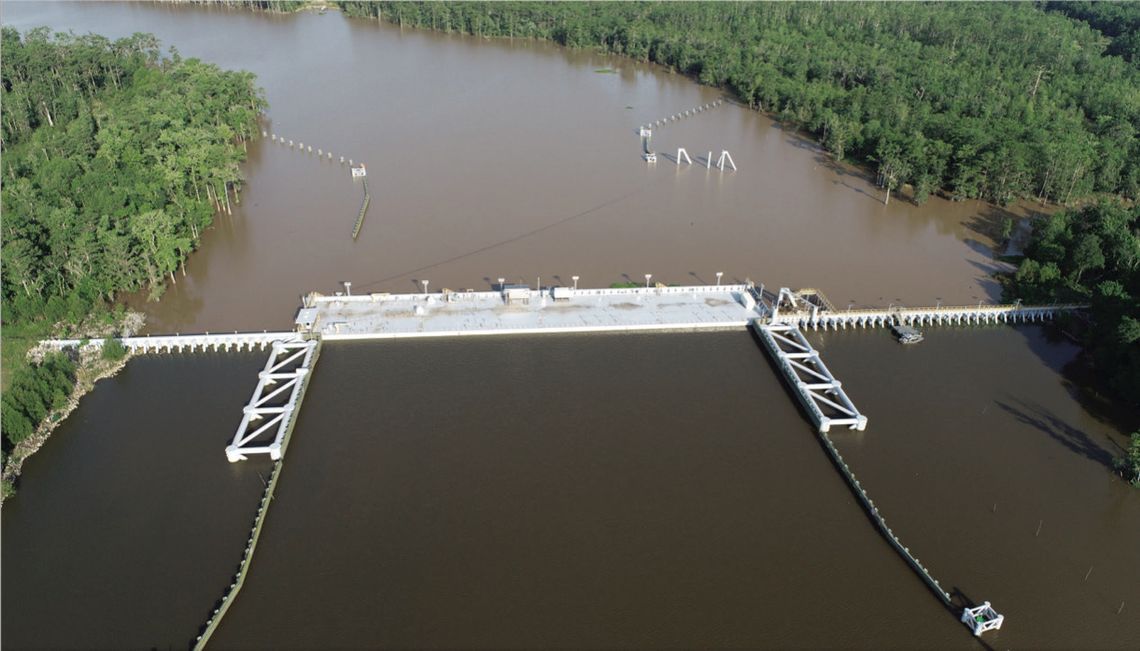
– St. Mary Levee District Executive Director Michael Brocato Jr. spoke to the St. Martin Parish Council at its meeting this past Tuesday about the Bayou Chene Control Structure, which can help prevent flooding in Lower St. Martin Parish by preventing water from pushing north during storms or other weather events.
The $80 million structure was completed south of Morgan City in 2022, protecting about 30,000 residents in six parishes along the east side of the Atchafalaya Basin from flooding.
The Stephensville area in Lower St. Martin Parish is among those areas.
At a certain level during flood events or storms, water in Bayou Chene begins rising and flooding areas north of there in St. Mary Parish, going toward Amelia and affecting areas to the north including Stephensville and Belle River and as far north as Iberville Parish.
Stephensville is one of the first areas affected by such flooding, Brocato said.
Closing the Bayou Chene Control Structure prevents the rising water from pushing north into the Lake Verret basin. If the water pushes north it blocks southward flowing waters and causes flooding.
Brocato said he understood that St. Martin Parish officials are concerned that the levee district doesn’t close the Bayou Chene gate early enough, but the permit issued by the U.S. Army Corps of Engineers says the structure can be closed when the gauge at Morgan City is at 7 feet or approaching 7 feet above the river level.
Control
In 2025, the gate was closed when the gauge rose to 4.08 on April 14 and continued climbing. It reopened on May 30 when it had dropped to 5.49 feet.
“Last year the prediction was that it was going to be 7.5,” Brocato said. “That was our trigger. That’s what gave us the opportunity to say, ‘Hey, we need to close the gate.’ We understand, we realize, the sooner we close it, the better off we’re going to be. If we allow it to hit the 7, you’re just allowing the water to fill that basin. You’re causing drainage problems for the whole basin.
“The other problem we run into is you start getting flows that are too heavy to close the gate. So we do close it early, earlier than anticipated.”
Commercial considerations are one concern for both the levee district and the St. Martin Parish Council.
Brocato said the structure opened a little earlier than officials would ideally have liked because there were a couple of big tows that needed to move down Bayou Chene from industry in the area.
But because the water gauges were falling, the gate could be opened at that point.
“We know that in Stephensville and Lower St. Martin, those water elevations where you start getting water on the streets, I’m talking just strictly on the streets, is about a plus-2,” Brocato said. “Right here we were at about a plus-2 on the gauges. The thing you’ve got to keep in mind is it’s plus-2 at that structure. That doesn’t mean that that basin is filled in. It takes a long period of time for that water to start filling in the basin to start causing the problems. We also knew that with the new structure, if we needed to close it again, it’s just a matter of pushing a few buttons and spending a little time out there closing it again.”
There were no flooding issues north of the structure for the 2025 incident, he said.
The IGA was supposed to be completed in 2019, and was agreed to, but not completed.
Costs for the structure in 2019 were supposed to be split among the parishes and levee districts involved, but the St. Mary Levee District footed the bill for that and subsequent modeling costs later.
Going forward costs are about $130,000 to $200,000 annually. The seven agencies involved are asked to put in $500,000 annually to the district’s coffers. Over the 10 years of the intergovernmental agreement, the money set aside would pay for dry docking and testing of the barge and structure every 10 years, Brocato said, and the operational and maintenance costs.
The cost share breakdown was divided among the parishes based on the number of residents affected in each parish. St. Martin Parish’s share would be 15 percent, or $75,000 per year.
Parish Councilman Hoyt Louviere asked about the agreement, which St. Martin Parish is the only parish not signed to at this point.
“I know there’s issues with the 7-foot on the river (mark triggering closure of the structure), but as we proved last year, when it’s time to close it, we’re going to close it,” Brocato said. “If you call and say, ‘Hey, we’re having problems,’ we’re going to take care of the people.”
Louviere said that is the concern for the parish. The parish government doesn’t mind paying the annual amount, but wants to make sure the people in the Stephensville area come first.
Parish President Pete Delcambre also said that another concern was whether signing the IGA would commit the parish to paying 15 percent of unforeseen costs such as repairs or replacement of the control structure, which the parish might not be able to pay.
“To commit 10 years from now or to give that onto another administration, an unfunded mandate, I don’t feel comfortable with it,” Delcambre said. “I do feel comfortable with $75,000 and a commitment (for 10 years to support the structure annually.”
Delcambre said that is a personal opinion as the parish council is who votes on the issue.
Brocato said the levee district works to prevent the need for major fixes in 10 years time by making sure it maintains the structure and tries to proactively address issues.
Brocato said that the funds for the structure were from the Coastal Protection and Restoration Authority, and CPRA might be willing to again put money into the structure if it needs major work, as long as it sees the local authority has money set aside and is maintaining the structure. Other money sources could be sought out as well.
“We just need the commitment from the parishes to be able to go to whoever it happens to be, whether it be the state, or the feds, and say, ‘Hey, we’re doing our part. Y’all need to do your parts.’”
Parish Council Chairman Chris Tauzin said the parish’s main issue all along has been the trigger point for closing the structure does not benefit Lower St. Martin Parish.
If the Corps of Engineers’ plan is followed by closing the structure at the 7-foot mark, there will be water in houses in Stephensville, he said.
St. Martin Parish’s issues with the spoil banks protecting the Cypress Island Community being taken by Lafayette Consolidated Government contractors in the dead of night a few years ago also raises trust issues for the parish, Tauzin said.
The Corps of Engineers has refused to do anything about that issue, even though its mandate is to prevent flooding in all parishes, including St. Martin, Tauzin said.
“If that commerce needs to get through, that trigger point (on the Bayou Chene structure) is going to change,” he said. “You know why? Because the Corps of Engineers, when they wrote it, they wrote it to benefit those people. Not St. Martin Parish.
“We came up with a simple idea. We’ll give y’all $75,000. We passed a resolution committing to y’all, as long as y’all protect our people. We’re looking out for the best interest of our people. If you continue closing that gate before Stephensville floods, we’re going to pay you every year. But the moment y’all flood us, guess what? I’m not paying you $75,000 to flood my people down there.”
Brocato said that signing the IGA gives St. Martin Parish a seat at the table and a voice in when the gate is closed. If St. Martin Parish signs the agreement and the parish president declares a state of emergency, the levee district will close the structure, Brocato said.
“We’re in the business of protecting people, period,” Brocato said. “It doesn’t matter if it’s St. Mary or St. Martin, we’re there.”
“That’s what we asked from the very beginning in the previous administration, that we change the trigger point on this project,” Tauzin said.
Easier said than done, Brocato said. It was a five-year period to set the permit level to begin with, and lawsuits are threatened by landowners on Avoca Island, south of Morgan City, every time the levee district brings up the idea of changing the trigger point. Closing the structure causes areas south of the structure, like Avoca Island, to flood sooner.
The parish council will reconsider signing the IGA and place it on the committee meeting agenda on Aug. 18, Tauzin said.