Get it growing
Weeds, at best, are annoying. At worst, they can take over your lawn or garden and choke out the plants you actually want to grow.
One of the worst of the worst is a group of plants called sedges. In fact, they’re considered some of the most troublesome weeds in the world, infesting crop fields, gardens and other green spaces in dozens of countries.
“Sedges are very difficult to control,” said Colton Blankenship, a horticulture weed scientist at the LSU AgCenter Hammond Research Station. “They do well in a variety of environments. They do well in turfgrass settings. They do well in landscapes. They really love wet areas.”
You’ve probably seen these weeds before and may have mistaken them for some kind of grass. But sedges belong to a separate plant family called Cyperaceae. Making this distinction is important, as managing sedges is very different from managing grass weeds, no matter how similar they look.
How can you tell if you’ve got a sedge on your hands? Remember this rhyme: sedges have edges. Unlike grasses, which have round stems, sedges have triangular stems. And, if you run your fingers through the plant, you’ll feel a third edge in the middle of each leaf.
Sedges also make themselves known with a rapid rate of upright growth that outpaces turfgrasses. They can colonize an area quickly — and they’re perennial, so they come back year after year.
Some sedge species owe their aggressive nature to a vast network of underground rhizomes and nutlike tubers, Blankenship said. This is true of the two most common sedges we deal with in Louisiana: yellow nutsedge (Cyperus esculentus) and purple nutsedge (Cyperus rotundus), which are sometimes collectively referred to as coco grass or nut grass.
Yellow and purple nutsedge can be distinguished by the color of their flower heads, which form in late summer. Purple nutsedge is a bit harder to get under control, Blankenship said, but he recommends similar management strategies for both species.
Herbicides are effective — if you choose the correct product.
“Really read that label,” Blankenship said. “That’s always important, but you especially want to make sure that sedges are listed on that label under the ‘weeds controlled’ section. If a product is designed just to kill grasses, it won’t kill a sedge.”
Hand-pulling is another option. Be sure to grab plants at their base and remove as much of the root system as possible. Try to remove plants while they are still small — and be persistent.
“You’re probably going to leave some of those tubers in the ground,” Blankenship said. “That’s going to be something you have to manage over time, and likely it’s going to be a few years of trying to pull them up and maybe even using herbicides depending on where they are. It’s going to be a long war and not an individual battle.”
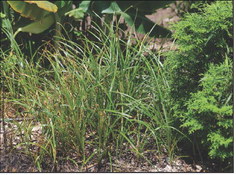
Sedges are notoriously tough weeds that thrive in both lawns and landscaped areas. (Olivia McClure/LSU AgCenter)