St. Martinville – Several residents spoke to the St. Martin Parish Council’s Public Works and Administrative/ Finance Committees protesting the request for rezoning property at 5958 Main Highway in St. Martinville from A-2 (Agricultral- Field Crops/Range Land) to I-3 (Heavy Industrial- Restricted).
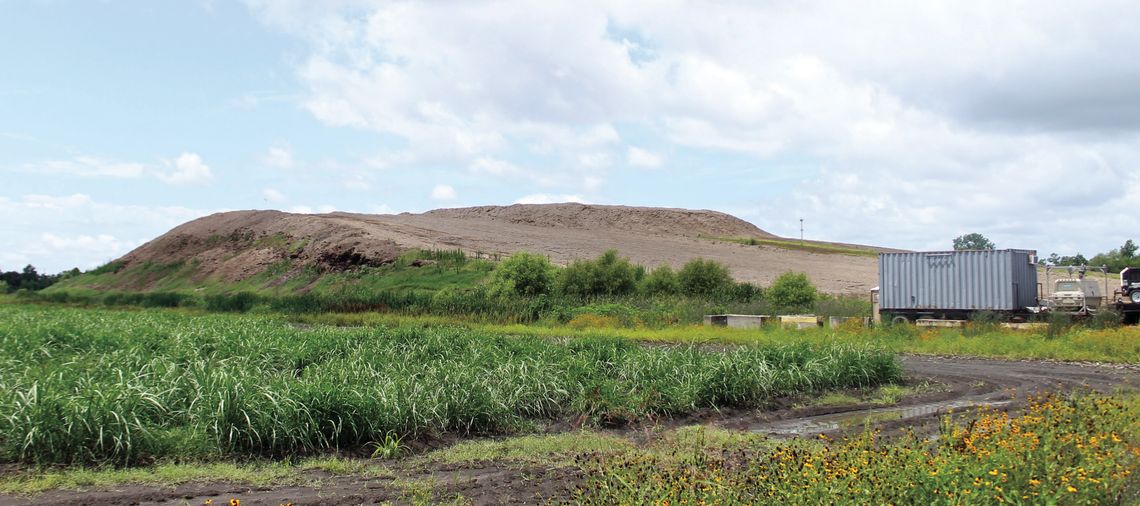
The property is being used to store bagasse, the fibrous, pulpy residue left behind after crushing sugarcane to extract its juice.
“Who wants these poisons in the air, in the water?” resident Cindy Guidry said. “Who wants their children or grandchildren playing (near that)?”
Guidry said that when she first moved to the area in 2019 to retire with her husband, the pile was the size of a dump truck load of dirt. It has grown continuously, and the moldy air and nasty water seeping from the pile are hazards to people living nearby, she said.
“It’s not healthy for anyone,” said Guidry, who said she loves her friendly neighbors but not the pile of sugar cane waste. “They haven’t covered it, put up retaining walls. You just hear them, night after night (depositing more bagasse). They don’t do it much during the day. I don’t know how these important safety protocols were ignored or walked over.”
Guidry said she fought cancer and survived, and said that her husband, who has since passed away, would not want his wife to have to live near the bagasse pile.
“I think if he were here now, he would not want me in this poison pit, this Mount Poison, I have so unaffectionately started calling it, because it’s going to kill me and my neighbors and everyone up and down the Teche because eventually it’s going to get to it,” she said. “It’s just a beautiful place and I don’t want to see it ruined and I don’t want to see all of our people die because of it. There’s ways to tend to this stuff, and it’s not putting it right next to a major highway right next to your neighbors. There’s always a crust coming from that pile across the way.”
Morris Laughlin asked that the requested property being used for bagasse be instead another 20 acres of land further away from residential properties or another 40 acres near Levert Road. He said that the property being used for storing the sugar cane waste is causing issues for nearby residents.
The original plans were presented as a possibility, then as a temporary solution, and have been used since 2018 or 2019, he said, so he has no faith in the current proposal. Moving the pile 2,000 feet back would not take away a single row of cropland, he said.
Virginia Schlueter said that residents have tried to turn the environmental concern for the bagasse pile.
Because the original proposal in 2019 was supposed to be temporary, she said, nothing was required of LASUCA by the state Department of Environmental Quality to plan for environmental concerns.
“As a result, there are no protections in place,” she said. “You have airborne bagasse. You have water seeping down, you have no signage — well, you have one small sign. There is no fencing. We know you have people on four-wheelers go up on a 60-foot mountain of bagasse who could slip down or get swallowed up. We know that on at least two occasions, people in our neighborhood have gone at least two weeks with a slow, smoldering fire (on the bagasse pile). That is why there are protections that the Department of Environmental Quality has placed on the storage of the sugar cane waste, the solid waste.
“What’s most disconcerting is that when we take the proper channels to ask the governing authorities to do something to right this wrong, and there is in fact a cease and desist order, we allow additional time to try to work through these problems amicably, as neighbors, reasonably. And in the interim, they get a law changed, 502 Senate Bill, passed in the Senate, passed in the House, and we did follow it through the legislative process on very short notice, that bagasse is now a hands-off byproduct. Local and municipal authorities have no right to intervene or to control the problems caused by a bagasse pile that’s out of compliance.”
LSU AgCenter representatives told concerned residents there was never a plan in place to deal with the issue because it was never intended to be permanent. Trying to use the cease and desist order to force a change in the zoning is the exact opposite of what the zoning commission decided in the first place, she said.
“So here we stand with a 60-foot, 8-1/2 acre pile of debris,” she said. “And we were asking for a reasonable solution. Is it necessary to change the zoning from agricultural, which it has been from the beginning of time, to industrial? I think it’s not necessary in light of the 502 effort that was made.”
Any change should be limited in duration in light of the fact that the sugar co-op went to the legislature to change the law, she said.
Craig Prosper said he had looked into what was said to be a similar situation in Thibodaux where a sugar cane mill was storing bagasse near a residential neighborhood.
Prosper said he visited the site and saw that it was different as the bagasse is on property contiguous with the mill property, so no trucks have to bring the waste through the neighborhood, and the bagasse is piled only about 10 feet high and spread over 30 acres there.
There also is drainage that takes water from the bagasse to a retention pond, and the pile is low so there is no airborne bagasse affecting the residential neighborhood.
“It’s totally different from what we have,” he said. “It’s definitely away from all homes, houses and everything else.”
There are thousands of acres available around the mill to put the bagasse, he said, without having to travel on main roads or near neighborhoods.
“Also I think part of our problem is probably 30 or 40 percent of this product is coming from another parish way up north” he said. “We’re having to eat it. We’re having to taste it. We’re having to breathe it because people are making a profit off of it. And look, I get it. I enjoy making profits and if they relaxed all the rules for me, I could probably make more money too. But they don’t do that for regular people. They do that for farmers.”
Prosper said that like Laughlin, he would like to see what the plan is that is being developed for the bagasse.
“I would like them to find a place for it too, because no one wants the mill to close,” he said. “None of us. The farmers don’t want the mill to close. And of course, the mill’s not going to close because of that. We all know that. I mean, how silly is that? But they came up here two weeks ago or a week ago and said that if they had to move the bagasse, pow, the mill would close. Come on. I think everybody in this room is smarter than that.”
A plan with best management practices and a better location would be supported by the community, he said.
St. Martin Hospital
St. Martin Hospital Service District No. 2 has moved from supporting a small independent hospital to supporting a thriving medical center that is part of the Ochsner Health, a non-profit healthcare provider in Louisiana, Mississippi and across the Gulf Coast.
Hospital Service District No. 2 Board President Burton Dupuis explained the history of Ochsner St. Martin Hospital in Breaux Bridge at the St. Martin Parish Council’s Public Works and Administrative/ Finance Committee Meeting this past Tuesday in St. Martinville.
The hospital was created in 1967 as St. Martin Hospital and was renamed Gary Memorial Hospital in honor of Charles Gary, who had spurred the creation of Hospital Service District No. 2 and who died two weeks after the creation of the district was approved.
In 2000, the hospital changed its name back to St. Martin Hospital when it became an affiliate of Lafayette General.
“Small hospitals were very successful from 1967 to ’85,” Dupuis said.
HIPAA, the Health Insurance Portability and Accountability Act, changed that when it was enacted in 1985, Dupuis said.
“It changed the Medicare reimbursement (process), so small hospitals became very vulnerable to the reimbursement,” he said. “In 1992, St. Luke Hospital (Service District No. 1), which covered Arnaudville, Cecilia and Henderson, closed. St. Martin Infirmary closed. Today they project that between 350 and 400 small hospitals have closed since 1985 throughout the country. We’ve been very fortunate.”
Dupuis explained the reasons for hospitals closing in response to a question from Councilman Vincent Alexander.
Prior to 1985, hospitals filed Medicare bills and got reimbursed 100 percent of the bill. That changed with the new HIPAA regulations.
In addition, Dupuis said, all of the local doctors were general practitioners. GPs had office practices but also did minor surgeries like tonsillectomies, gall bladder removal and minor orthopedic work like putting casts on broken arms.
The HIPAA rules change led to many doctors retiring, and to family practices referring patients to specialists for procedures like tonsillectomies and casts being placed on broken limbs.
Between 1985 and 1987, St. Martin Parish lost seven physicians to retirement, Dupuis said. Three in Arnaudville retired, two in Breaux Bridge retired and two in St. Martinville retired.
At the same time, three physicians returned to practice in Breaux Bridge, but they were family practitioners who practiced out of their office.
“What HIPAA did, it not only changed the reimbursement, it changed the practice,” Dupuis said.
St. Martin Hospital became an affiliate of Lafayette General in 2000 and in 2009 Lafayette General began leasing the facility, with the service district collecting rent and being responsible for property and general liability insurance coverage. LGH merged with Ochsner Health in 2020.
“When we began the journey in 1992, we had a hospital and one physician’s office building,” Dupuis said. “Today we have a hospital and 10 physician office buildings.”
The hospital has the only emergency room in St. Martin Parish and also provides a walk-in health clinic for patients.
There are three main entrances to the hospital, Dupuis said. The emergency room entrance leads to the ER with an ER parking lot servicing that area.
The inpatient entrance leads to inpatient services, with a separate inpatient parking lot.
Outpatient services are reached from the outpatient parking lot via the outpatient entrance.
“Our facility is very simple to use,” Dupuis said. “It’s used throughout St. Martin Parish. What we hope is that as long as we have (Lafayette) General with us, we see the future to be very good.”
Parish President Pete Delcambre said that St. Martin Parish is fortunate to have Dupuis and the hospital service district board members who have kept the facility open and helped expand it when hundreds of small hospitals across the country have been closed.
Parish Council Chairman Chris Tauzin also had praise for the hospital, saying he has had family members use the hospital in recent years and the facility and people there are second to none, adding that the convenience of having the hospital so near also is appreciated.
Dupuis thanked the council for its support and cooperation with the hospital service district.
Parish projects
Delcambre spoke to the council in his President’s Report about the public works projects currently underway in the parish.
Zoning changes
The committees heard from property owner Andrew Babineaux about a rezoning request at 1002 Orchard Park Drive to change from residential to commercial for use as a parking lot for his club adjacent to the property, as has been discussed at the past couple of council meetings.
District 7 Councilman Vincent Alexander raised objections to the rezoning request, saying Orchard Park residents do not want the land rezoned and noted that the parish Planning & Zoning Commission had not recommended rezoning the land to the parish council.
In other business
The council met in executive session to discuss its lawsuit with Lafayette Consolidated Government concerning the removal of a spoil bank in St. Martin Parish in 2022.
Parish attorney Lee Durio said the council and president had a good discussion on strategy for how to move forward and looks forward to a resolution to the lawsuit, with hope, in the near future.
The council also considered a resolution to grant a Certificate of Substantial Completion to the Cypress Island/Joe Daigre Drainage System Maintenance Project, Phase 2, which is complete except for some punch list items.
The council also considered a resolution appointing Stacey Blanchard Bouquet as the St. Martin Parish Homeland Security and Emergency Preparedness Director.
Delcambre also spoke about parish public works projects, including the water consolidation project.
He also spoke about the parish paying half the cost of a $125,000 bill incurred by the City of St. Martinville for emergency repairs to the lift station down by Bayou Teche near the jail. Debris discarded from the parish jail into the sewer system helped contribute to the problem, Delcambre said, and the administration felt that paying half the cost was reasonable. The parish also has looked into the cost of replacing sewer lines in the building and building a catch basin for the jail to help prevent those problems in the future. The catch basin and related costs are estimated to be about $100,000 with Delcambre planning to budget $125,000 to cover cost overruns or other unforeseen issues.