Go to main contentsGo to search barGo to main menu
Wednesday, March 4, 2026 at 3:52 PM

Freeze damage can mimic disease symptoms in palms

Freeze damage can mimic disease symptoms in palms
These Chinese windmill palms show lethal yellowing symptoms. (LSU AgCenter file photo)

Get it growing

For a long time in Louisiana, the biggest risk that came with growing palms was incurring freeze damage in the winter. In the past decade, however, two diseases have emerged as new threats to these beautiful tropical plants.

The diseases — lethal bronzing and lethal yellowing — are closely related and affect several palm species. They’ve been reported in parishes across southern Louisiana, with infections concentrated in the Baton Rouge and New Orleans areas.

“Both those diseases are terminal,” said LSU AgCenter plant doctor Raj Singh. “But they don’t produce unique symptoms so that you can easily separate them from abiotic disorders like freeze injury.”

Lethal bronzing and lethal yellowing cause palms’ fronds to turn brown. This is where things get confusing: It’s perfectly normal for palms to exhibit similar symptoms following freezing temperatures and as older fronds die off.

“A lot of palms have been sacrificed because a homeowner or landscaper thought they had a disease that was actually freeze damage,” Singh said.

Wondering whether your palm has a disease — or if it was simply affected by recent freezes?

There are a few telltale signs of lethal bronzing and lethal yellowing: Speed. Palms infected with these diseases turn brown and die quickly. There is no transition period from green to yellow to brown, Singh said; instead, fronds become brown almost immediately. Palms succumb to the infection within three to five months of the onset of symptoms. Cold injury, by contrast, often appears in stages beginning seven to 10 days after a freeze.

Lower canopy separation. Infected palms’ lower fronds turn brown, droop and separate from the upper canopy. “The top of the palm will look like a mushroom,” Singh said. “In the case of a freeze, the entire palm canopy exposed to cold temperature turns tan to brown.”

Dead spear leaf. The young, unopened frond at the top of a palm is known as the spear leaf. “If you see the spear leaf is dead, that means the palm is definitely infected with one or the other disease,” Singh said.

While these clues can point toward a lethal bronzing or lethal yellowing infection, they’re not enough to definitively say a palm is infected. To do that, you’ll need to send in a sample to the AgCenter Plant Diagnostic Center, which Singh oversees.

It’s worth taking this extra step to figure out for sure whether one of these diseases or a different ailment or an abiotic stressor is in play. Freeze-damaged palms sometimes — but not always — can recover with proper care and don’t necessarily have to be removed from the landscape.

A palm stricken with lethal bronzing or lethal yellowing, on the other hand, needs to be taken down immediately. This can help prevent disease spread to nearby palms, and the infected palm will die soon anyway.

“Once the palm is infected, there is no cure,” Singh said.

Preventative treatments are available to help healthy palms resist phytoplasma infection, which is transmitted and spread by a small leafhopper insect called Haplaxius crudus.

“They will feed on the phloem of the palm, and while they’re feeding, they will transmit the phytoplasma into the phloem system of the plant,” Singh said.

The phytoplasma hampers translocation of nutrients inside the palm, essentially starving it to death.

If you’re interested in growing palms, you can be careful in choosing species as another preventative measure. Canary Island date palms, Chinese fan palms, Chinese windmill palms, medjool date palms, queen palms and silver date palms are all susceptible to lethal bronzing and lethal yellowing. Sabal, or cabbage, palms are a bit more tolerant of these diseases than other species.

You can find more information about these diseases and learn how to submit samples to the Plant Diagnostic Center by visiting www.LSUAg-Center.com/PlantDiagnosticCenter.

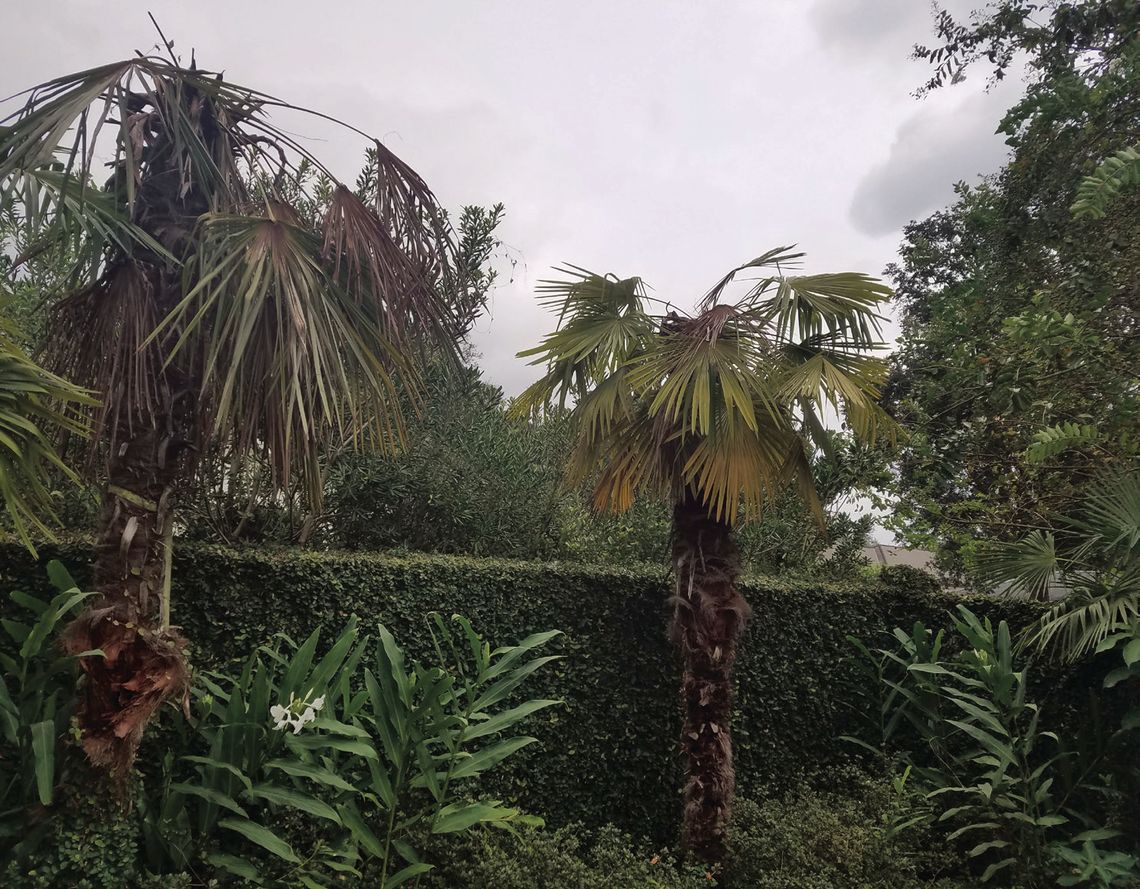
This silver palm exhibits symptoms associated with freeze damage. (LSU AgCenter file photo)

Share
Rate

e-Edition
Teche News