Get it growing
The cooler months are ideal for planting many tree species in Louisiana. Staking newly planted trees can offer much-needed support as they start to put down roots — especially in the case of large trees.
“When you get that instant effect from a mature tree being put into the landscape, you’ve got a lot of top-heavy growth, but you don’t have the root ball to accommodate that,” said Damon Abdi, assistant professor of landscape horticulture at the LSU AgCenter Hammond Research Station. “Staking is a great method to be able to give a little bit of stability to the tree as it’s integrating into its new landscape.”
Staking prevents the root ball from shifting and incurring damage while the tree acclimates to its surroundings. To reap the benefits of staking, however, you must do it properly. Follow these steps from Abdi for the best results.
Step 1: Install stakes Gather two to three stakes about 6 feet long. Many people use metal fenceposts or rebar.
Place the stakes in the native soil surrounding the tree, spacing them equally.
“You don’t want the stakes to be within the root ball, or else it defeats the purpose,” Abdi said.
Drive the stakes about 2 feet into the ground.
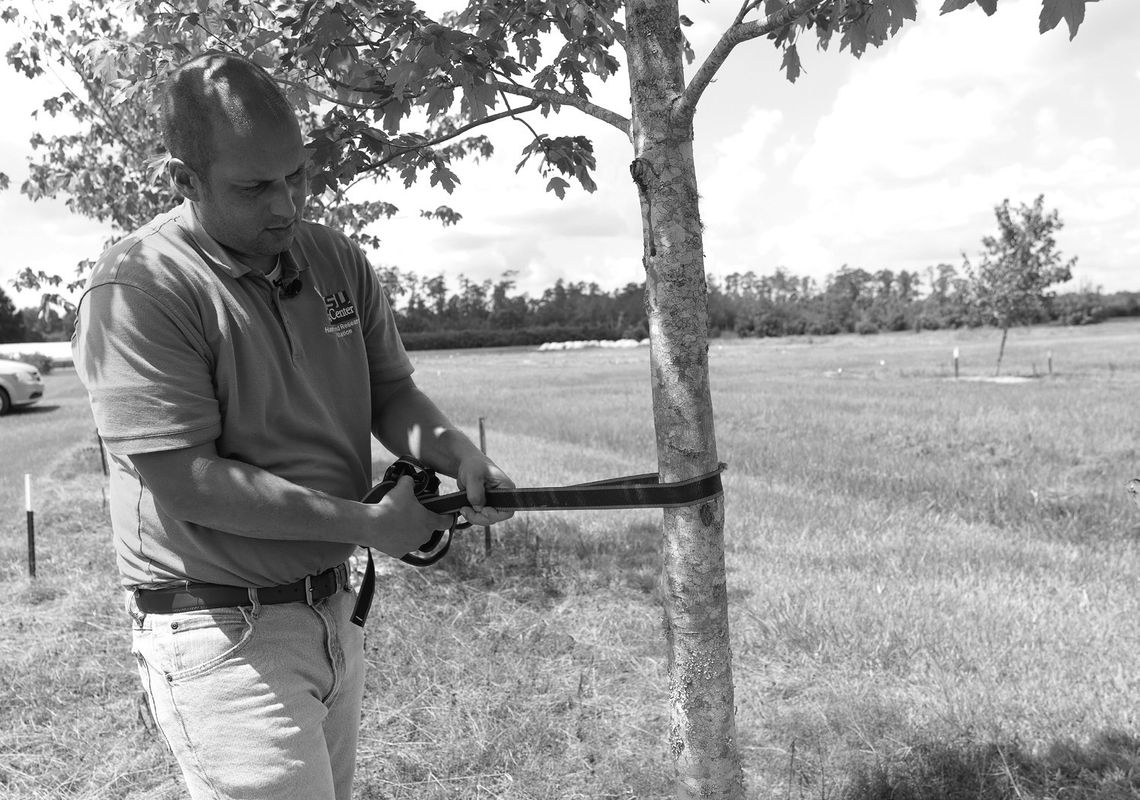
Step 2: Connect stakes to tree Next, you’ll need to connect the stakes and the tree. Using the proper materials is key.
“You don’t want a thin metal material such as a wire, or else it’s going to act like a cheese cutter and cut through the trunk,” Abdi said. “Instead, you want something that’s nice and broad to displace the pressure over a wider area.”
Polyester webbing or a similar soft, woven strap material is a good choice. You also can use plastic chain lock tree ties, which are more discreet. Another option is thin rope — again, not wire — threaded through a short piece of hosepipe, which provides a protective shield around the trunk.
Loop the straps or other ties around the tree about one-third to two-thirds of the way up the trunk, leaving some wiggle room.
“Regardless of what