Agricultural producers throughout Louisiana are embracing precision agriculture — a management strategy that relies on drones, sensors, artificial intelligence and other advanced technologies to collect data and make informed decisions to improve crop yields.
For decades, LSU Ag-Center researchers and extension agents have researched and taught producers about precision agriculture tools, such as sensors that aid in identifying plant stress and pinpoint crops’ fertilizer needs or variable rate technologies that can apply right amount of fertilizer, herbicide, fungicide and water at the right location.
As the precision agriculture realm has grown, the AgCenter has increased research and educational efforts to advance the field and added specialists, such as Congliang Zhou, an assistant professor for research and extension.
“For crop production, we need to have a lot of inputs — fertilizer, water, pesticides,” said Zhou, the AgCenter precision agriculture extension specialist. “But not every plant needs the same amount. Precision means trying to find out the exact amount of input a plant needs.”
On Dec. 10, growers connected with Ag-Center experts, state officials and representatives from the precision agriculture industry at the AgCenter’s Precision Agriculture Summit in Alexandria. At the summit, AgCenter researchers and extension specialists presented their findings on a wide range of topics that fit within the parameters of precision agriculture.
Precision agriculture research at the AgCenter explores several different avenues: using sensors to analyze soil and plant needs, testing sprayer drones that target weeds or dispense harvest aids over sugarcane, developing smartphone applications that can identify insects and many other projects.
These technologies have the potential to save producers time and money while also alleviating farm labor shortages, according to Raghav Goyal, an economist in the AgCenter Department of Agricultural Economics and Agribusiness.
“Precision agriculture can generate great economic benefits provided we use it in the right way,” Goyal said while presenting at the summit.
Many precision agriculture technologies have developed slowly over the past 40 years, Zhou said, and recent technological advancements have accelerated the field’s progress.
For more than a decade, AgCenter engineer Randy Price has worked to test and improve agricultural drones while educating producers and young people about the technology. He has seen rapid improvements in unmanned aerial vehicles and has noticed an uptick in farmers adopting them.
“It looks viable now, and there is a lot of interest,” said Price, who is an associate professor based at the AgCenter Dean Lee Research and Extension Center in Alexandria. “They are remotely piloted, so it’s really safe for the pilot. We don’t worry about someone getting hurt or killed. And they are low cost — $20,000 to $30,000 or cheaper — and you could buy something and start spraying after meeting a few rules versus an airplane that’s $1 million or more or a (tractor-based) spray rig that is $500,000 or more. So, they’re really lucrative from those standpoints.”
Many Louisiana growers were introduced to precision agriculture through variable rate technologies, which relies on high-tech farm implements to vary the amounts of inputs such as fertilizer or pesticides applied to a field. The application amounts differ because of crop needs in specific areas, and these technologies can save farms money and prevent excess nutrients from washing off the field into waterways, said Brenda Tubaña, professor of soil fertility in the AgCenter School of Plant, Environmental and Soil Sciences.
“You’re not wasting fertilizer nor applying for nothing,” Tubaña said during her presentation at the summit.
During a panel discussion at the event, growers explained that precision agriculture has helped them become more efficient and save money, especially through variable rate technology. Using large drones to spray ripeners that aid in harvesting sugarcane has delivered a great return on investment for some producers and has allowed them to spray the ripeners, which promote sugar accumulation before harvest, at an optimal time.
“I want to sweeten my cane when I want to sweeten my cane,” said Josh Hebert, a central Louisiana farmer who bought a drone so he did not have to wait for a crop duster during the busy preharvest season.
Improvements in artificial intelligence also have unlocked new pathways for digital agriculture tools.
Ivan Grijalva, an Ag-Center assistant professor focused on precision pest management and data analytics, applies machine learning to train computers to detect redbanded stink bugs and other pest-related challenges, including weeds and diseases. He aims to develop technologies that help farmers scout fields more efficiently and generate prescription maps to guide management decisions and minimize chemical inputs.
Zhou has developed a robot that moves through sugarcane fields to help count cane stalks and assist with sugarcane breeding and variety development.
“When the robotic system is moving through the field, the sensor will collect data from different angles of each plot,” Zhou said. “Humans can only see from one angle. That’s the advantage. Then, AI can process the data in the field in real time, and based on our preliminary results, it will be more accurate than people we send into the field.”
The future of precision agriculture is “very exciting to see,” Zhou said. For now, most precision agriculture technologies require a great deal of human labor, whether operating spraying drones or analyzing data. That work will eventually be automated, too, Zhou said.
“Because labor shortages are a top issue for American agriculture,” he said, “I feel like AI and automation will be the future.”
To learn more about precision and digital agriculture, visit https:// www.lsuagcenter.com/ topics/digital-agriculture.
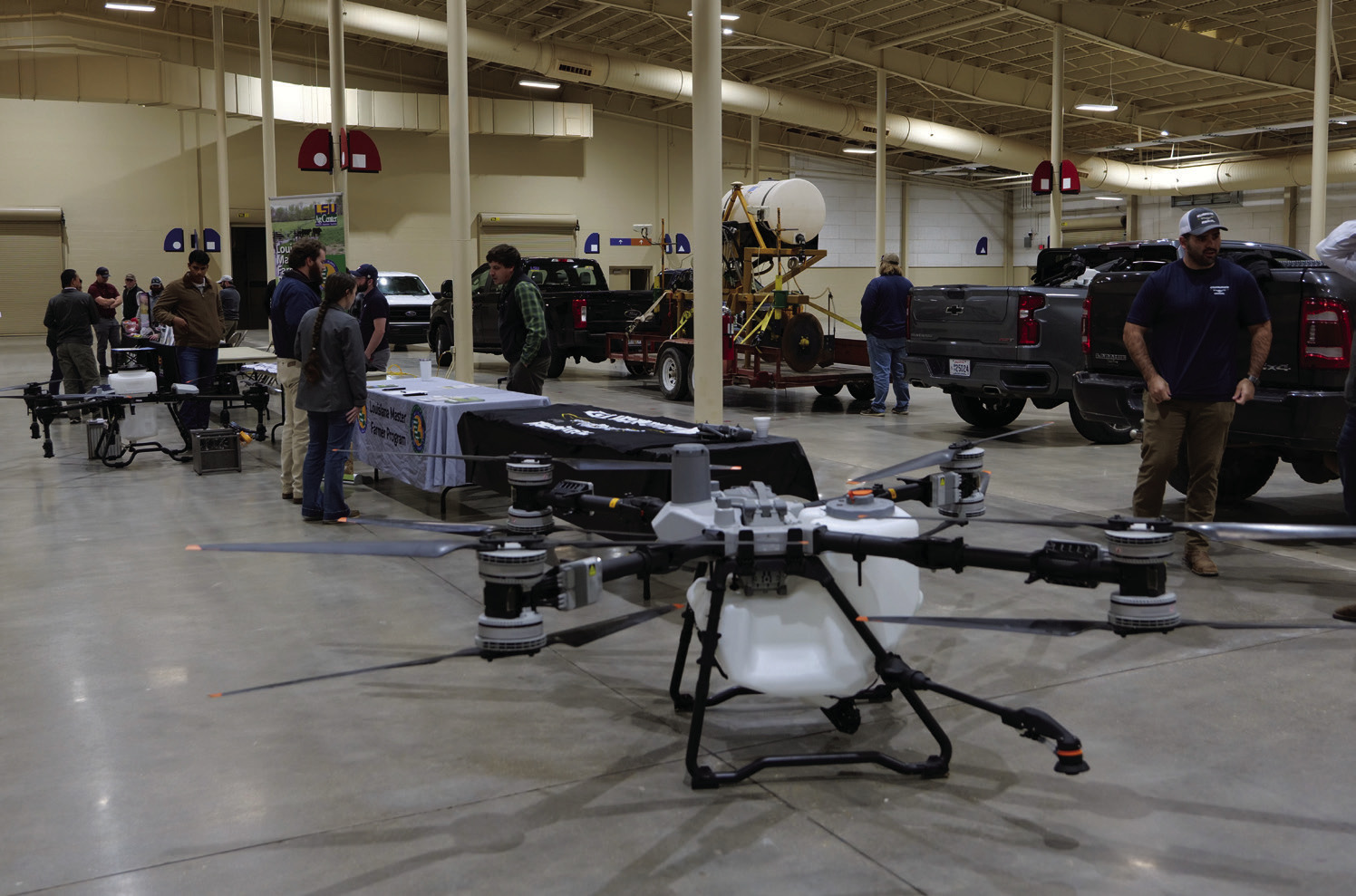
A sprayer drone and other implements used in precision agriculture are displayed during the Precision Agriculture Summit in Alexandria. (Kyle Peveto/LSU AgCenter)